
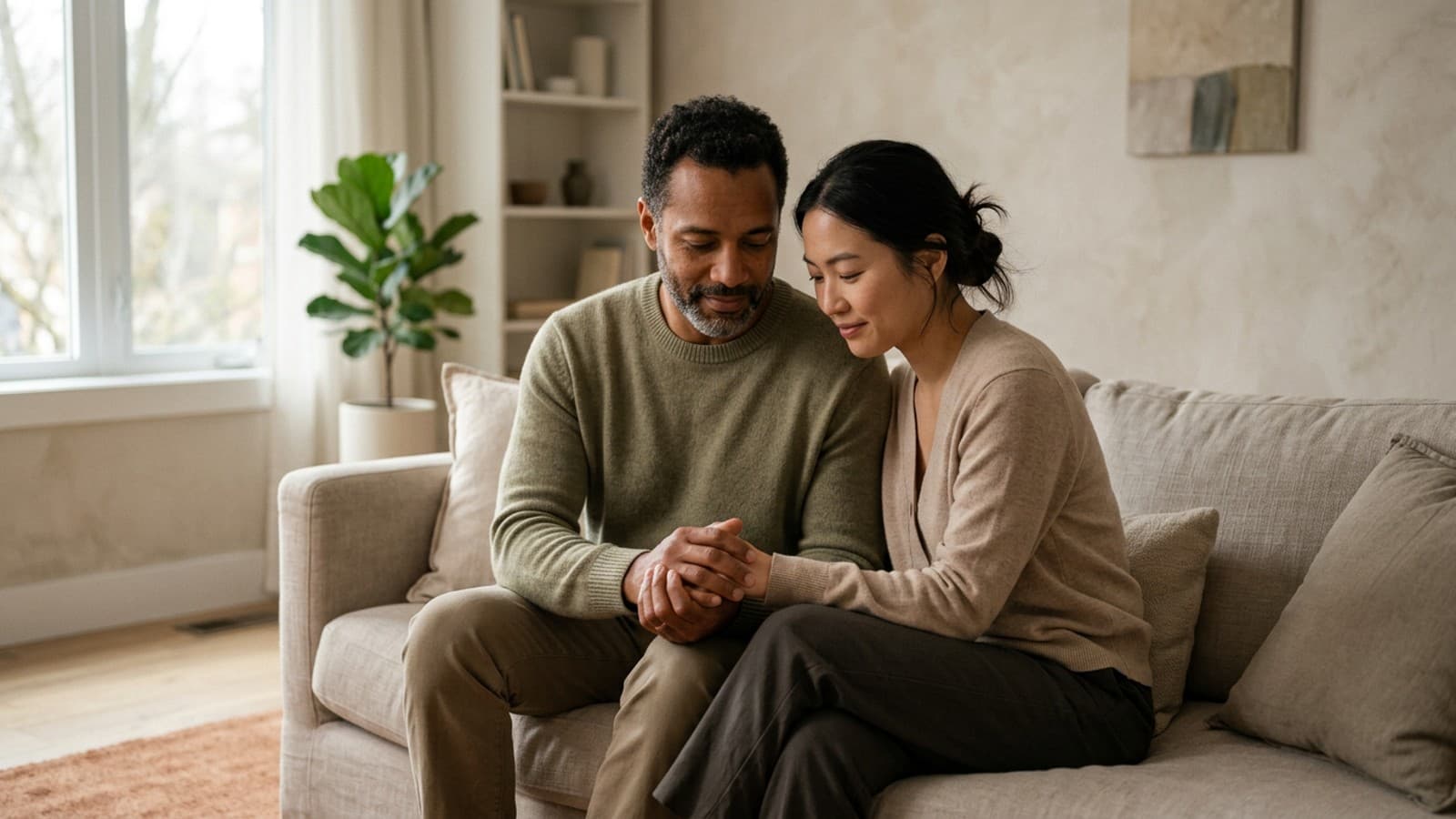
Healing relationships counseling is a strengths-based, holistic approach to couples therapy that focuses on repairing emotional wounds, rebuilding connection, and creating lasting relationship change. Unlike approaches that only address surface-level conflicts or teach communication techniques in isolation, healing-centered counseling recognizes that relationship distress often stems from deeper emotional injuries—unmet needs, broken trust, accumulated resentment, or patterns of disconnection that have eroded the foundation couples once shared.
This approach treats relationship repair as a process of genuine healing rather than quick fixes. It addresses the heart, mind, and spirit of the relationship, working with both partners to understand what's hurting, what's missing, and what's needed to restore emotional safety, trust, and intimacy. Research supports this comprehensive approach: a 2022 review in the Journal of Marital and Family Therapy examining evidence-based treatments found that well-established couple therapy approaches—including behavioral, cognitive-behavioral, emotionally focused, and integrative methods—all share a focus on healing relational wounds and restoring connection (Doss et al., 2022).
For couples who feel stuck in painful patterns, who've tried to fix things on their own without success, or who wonder whether their relationship can be saved, healing relationships counseling offers a structured, evidence-based path forward.
What Makes Healing Relationships Counseling Different?
Traditional couples counseling often focuses narrowly on conflict resolution or communication skills. Those elements matter, but they're not sufficient when the underlying issue is emotional disconnection, betrayal, or long-standing resentment.
Healing relationships counseling takes a broader view. It recognizes that relationships break down when emotional safety erodes, when partners stop turning toward each other, when trust is damaged, or when the friendship that once sustained the partnership fades under stress. Fixing these issues requires more than learning to use "I" statements—it requires rebuilding the emotional foundation itself.
Strengths-based focus. Healing-centered approaches don't pathologize struggling relationships. Instead, they identify what's already working, what drew you together in the first place, and what strengths you can build on. Even couples in significant distress have moments of connection, shared values, or care for each other that can be nurtured and expanded.
Holistic care. Healing relationships counseling addresses the whole relationship—emotional intimacy, communication patterns, conflict cycles, trust, physical intimacy, shared meaning, and the practical realities of daily life together. It recognizes that a relationship is more than the sum of its problems, and healing requires attending to all the dimensions that create closeness or distance.
Trauma-informed perspective. Many relationship wounds—betrayal, persistent criticism, emotional abandonment, or feeling fundamentally unseen by your partner—create trauma-like responses. A healing approach understands this and creates safety first, then moves toward repair and growth at a pace both partners can sustain.
Why Does Healing Relationships Counseling Work?
The research on couples therapy effectiveness is clear: therapy works when it addresses both the symptoms (the fights, the withdrawal, the disconnection) and the underlying relational injuries causing those symptoms. Evidence-based couple therapy approaches consistently demonstrate positive outcomes when they focus on healing relational wounds rather than just managing surface conflicts.
It Creates Emotional Safety
Couples in distress often can't have productive conversations at home because emotional safety has broken down. One or both partners become defensive, shut down, or escalate quickly. Healing relationships counseling provides a structured, neutral space where both partners can speak and be heard without the conversation devolving into the same painful patterns.
The therapist acts as both guide and protector—ensuring conversations stay productive, calling out destructive dynamics when they surface, and teaching both partners to recognize when they're flooding (becoming so emotionally overwhelmed that productive dialogue becomes impossible). Over time, couples internalize these skills and can create safety for each other even outside the therapy room.
It Addresses Root Causes, Not Just Symptoms
The same fight about dishes, schedules, or parenting decisions that keeps recurring often isn't really about dishes or schedules. It's about feeling unheard, unvalued, or alone in the relationship. Healing relationships counseling helps couples understand what's underneath the surface conflict.
Research on evidence-based approaches like the Gottman Method shows that addressing underlying friendship, emotional attunement, and shared meaning—not just conflict management—is key to lasting relationship improvement. When therapy targets root causes, the surface conflicts often resolve themselves.
It Rebuilds Connection Before Solving Problems
Many couples enter therapy believing they need better conflict-resolution skills. What they actually need first is to reconnect emotionally. Healing-centered approaches prioritize rebuilding the friendship, restoring positive interactions, and helping couples remember why they chose each other before diving into problem-solving.
When emotional connection is present, couples can navigate disagreements much more effectively. When it's absent, even perfect communication techniques fail because partners don't trust each other's intentions or care about each other's needs.
This is why evidence-based approaches like the Gottman Method focus heavily on building "Love Maps" (detailed knowledge of your partner's inner world), creating rituals of connection, and increasing positive interactions before teaching conflict-management skills. Healing the relationship comes first; solving specific problems follows naturally.
It Works Across Different Relationship Challenges
Healing relationships counseling isn't limited to one type of problem. The same principles that help couples rebuild after infidelity also help couples navigating communication breakdown, emotional distance, parenting conflicts, life transitions, or the slow drift that happens when life gets busy and the relationship takes a back seat.
A 2022 evidence review in the Journal of Marital and Family Therapy found that evidence-based couple therapies showed effectiveness across a wide range of presenting issues—not just "communication problems" but also infidelity, mental health challenges affecting the relationship, intimacy concerns, and relationship distress stemming from external stressors (Doss et al., 2022). A healing-centered approach adapts to the specific wounds each couple brings while maintaining the core focus on emotional repair and connection.
What Does Healing Relationships Counseling Look Like in Practice?
While different therapists and therapeutic approaches have unique frameworks, healing-centered couples therapy generally includes these core elements:
Assessment of relationship strengths and struggles. Early sessions focus on understanding both what's not working and what is. What are the recurring conflict patterns? Where has trust been damaged? But also: What still connects you? What do you appreciate about each other? Where do you still turn toward each other, even imperfectly?
Creating safety and regulating emotions. Couples learn to recognize when they're emotionally flooded and practice self-soothing and taking productive breaks. The therapist helps both partners feel safe enough to be vulnerable and to hear hard truths without shutting down or attacking.
Addressing the specific wounds. If betrayal happened, it must be acknowledged, processed, and repaired. If one partner feels chronically criticized or dismissed, that pattern must be interrupted and replaced. If emotional intimacy has faded, the couple explores what created distance and how to rebuild closeness. Healing doesn't happen by avoiding the painful topics—it happens by addressing them with care and structure.
Rebuilding communication and connection. Couples learn to express needs without criticism, to listen without defensiveness, to make and accept repair attempts, and to turn toward each other's bids for connection. These skills become the foundation for daily interactions that sustain healing over time.
Restoring intimacy and shared meaning. As emotional safety and trust rebuild, couples can restore both emotional and physical intimacy. They also work on creating shared meaning—understanding each other's dreams, values, and life goals, and building a relationship that honors both individuals while creating something larger together.
How Long Does Healing Take?
There's no universal timeline. Some couples notice significant shifts within weeks; others need months or even a year or more, especially when rebuilding after betrayal or long-standing disconnection.
What matters more than speed is consistent progress. Are you having more productive conversations at home? Are you noticing and responding to each other's bids for connection? Is trust slowly rebuilding? Are the painful patterns showing up less frequently or with less intensity?
Healing relationships counseling isn't about rushing to "fix" things. It's about creating sustainable change that lasts long after therapy ends. The couples who benefit most are those who commit to the process, practice the skills between sessions, and show up with genuine willingness to understand their partner's experience—even when it's hard.
What If the Relationship Feels Too Broken?
Many couples delay seeking help because they fear it's "too late" or the damage is irreparable. The research offers hope: couples dealing with even severe relationship distress—including infidelity—can recover when both partners commit to the work with structured, evidence-based therapeutic approaches. The key factors aren't how bad things have gotten—they're whether both partners are willing to engage, whether they work with a therapist trained in evidence-based approaches, and whether they give the process time to unfold.
If you're unsure whether your relationship can be saved, therapy can help you explore that question with clarity and support. For some couples, healing means rebuilding the relationship. For others, it means separating with mutual respect and understanding rather than bitterness. Either way, the process offers value.
How Do You Find a Healing-Centered Couples Therapist?
Not all couples therapy is healing-centered. When searching for a therapist, look for:
Evidence-based training. Therapists trained in approaches like the Gottman Method, Emotionally Focused Therapy (EFT), or Imago Relationship Therapy bring structured, research-backed frameworks for healing relationship wounds.
Specialization in couples work. A therapist who primarily works with individuals and occasionally sees couples won't have the depth of training needed to address complex relationship dynamics. Look for someone whose practice focuses on couples and marriage therapy.
Trauma-informed care. If your relationship has experienced betrayal, chronic criticism, emotional abuse, or other wounding patterns, ensure the therapist understands trauma responses and can create safety for both partners.
Strengths-based philosophy. A healing approach sees your relationship's potential, not just its problems. The therapist should help you identify what's working and build on it, not just catalog everything that's broken.
A good fit for both partners. Both of you should feel the therapist is fair, sees both perspectives, and creates space for both voices. If one partner feels the therapist is taking sides, healing becomes much harder.
When Should You Seek Healing Relationships Counseling?
The best time to seek help is earlier than most couples think. Waiting until you're on the brink of separation makes the work significantly harder. Consider reaching out if you're noticing signs that your marriage needs attention—recurring conflicts, emotional distance, loss of intimacy, contempt creeping into interactions, or avoidance of important conversations.
You don't need to be in crisis to benefit from counseling. In fact, couples who seek help when they first notice concerning patterns have better outcomes than those who wait years. Early intervention prevents small wounds from becoming deep relationship injuries that require much more time and effort to heal.
Healing relationships counseling offers a path from disconnection to genuine closeness, from pain to repair, from patterns that hurt to patterns that sustain. The research is clear: with the right approach, skilled guidance, and mutual commitment, even deeply distressed relationships can heal.
If you and your partner are ready to begin the healing process, the therapists at Marriage Healing Center in Gainesville and Alexandria, Virginia, specialize in helping couples repair relationship wounds and rebuild lasting connection. Led by Dr. Beverley Boothe, Ph.D., MSW, LCSW, our team is trained in the Gottman Method, Emotionally Focused Therapy, and Imago Relationship Therapy—evidence-based approaches designed to heal the heart, mind, and spirit of couples who are hurting. We offer in-person therapy in Northern Virginia and online e-therapy for Virginia residents. Reach out to schedule a consultation—healing is possible, and you don't have to navigate this alone.
References
Doss, B. D., Roddy, M. K., Wiebe, S. A., & Johnson, S. M. (2022). A review of the research during 2010–2019 on evidence-based treatments for couple relationship distress. Journal of Marital and Family Therapy, 48(1), 283–306. https://pubmed.ncbi.nlm.nih.gov/34866194/